
Discover Talayotic Menorca: Naveta des Tudons, Torre d’en Galmés, Talatí de Dalt and the island’s main prehistoric sites.
Menorca is known for its turquoise coves, lighthouses and the Camí de Cavalls, but the island also preserves another extraordinary heritage that often goes unnoticed by first-time visitors.
We are talking about Talayotic Menorca, one of the most important prehistoric archaeological ensembles in the Mediterranean and a UNESCO World Heritage Site since 2023.
Across the island you will find talayots, funerary navetas, taula enclosures, rock-cut necropolises and ancient settlements that reveal how Menorca’s communities lived thousands of years ago.
You do not need to be an archaeology enthusiast to enjoy them. Many are surrounded by Menorca’s rural landscape and can easily be combined with towns, beaches and other visits.
In this Menorca4You guide we select some of the essential sites of Talayotic Menorca and suggest a route to discover them.
The most important things you need to know
- Talayotic Menorca has been part of the UNESCO World Heritage List since 2023.
- The island preserves an exceptional concentration of prehistoric monuments.
- Talayots, taulas and navetas are some of its most characteristic structures.
- The archaeological sites are spread across different parts of Menorca.
- Having a car makes it much easier to organise an archaeological route.
- Some places are free to access while others require an entrance ticket.
- Opening hours and access conditions may change depending on the season.
- Spring and autumn are especially pleasant times to visit them.
- Wear comfortable shoes and bring water and sun protection.
What is Talayotic Menorca?
Talayotic Menorca refers to the extraordinary collection of archaeological remains that document the lives of the island’s prehistoric communities.
One of its most recognisable features is the talayots, large stone structures that dominated many settlements.
But they are not the only ones.
In Menorca you will also find the famous funerary navetas, taula enclosures, circular houses, funerary caves and rock-cut hypogea.
What is most striking is the state of preservation of many of these places and the way they remain integrated into Menorca’s landscape.
- Naveta des Tudons
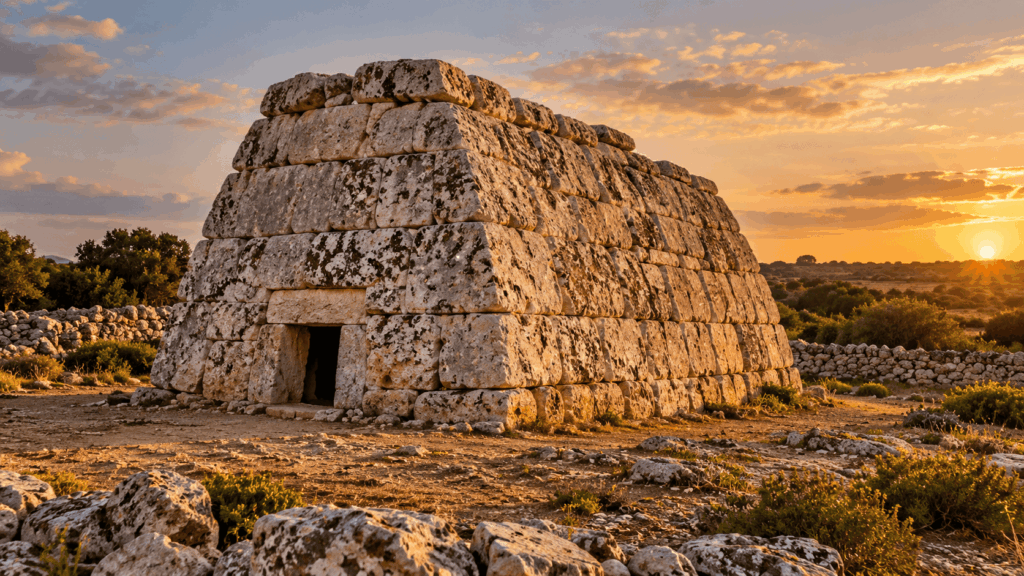
Naveta des Tudons is probably Menorca’s best-known prehistoric monument.
It is located a few kilometres from Ciutadella, beside the island’s main road.
Its shape resembles an upside-down boat and it was used as a collective funerary structure.
It is built from large stone blocks placed without mortar, a technique characteristic of Menorca’s prehistoric architecture.
The visit does not take long, so it is very easy to include it in a route around western Menorca.
Ideal for
A first introduction to prehistoric Menorca and for combining with a visit to Ciutadella.
- Torre d’en Galmés
If you are only going to visit one large Talayotic settlement, Torre d’en Galmés should be among your first choices.
Located near Alaior and Son Bou, it was one of the island’s most important prehistoric settlements.
The site allows you to see different types of structures and better understand how these settlements were organised.
Its elevated position also offers beautiful views towards southern Menorca.
It is worth spending considerably more time here than at Naveta des Tudons.
Ideal for
Those who really want to understand what a settlement in prehistoric Menorca was like.
- Talatí de Dalt
Talatí de Dalt is located near Maó and is one of the best-known archaeological complexes in the eastern part of the island.
One of its main attractions is its taula enclosure.
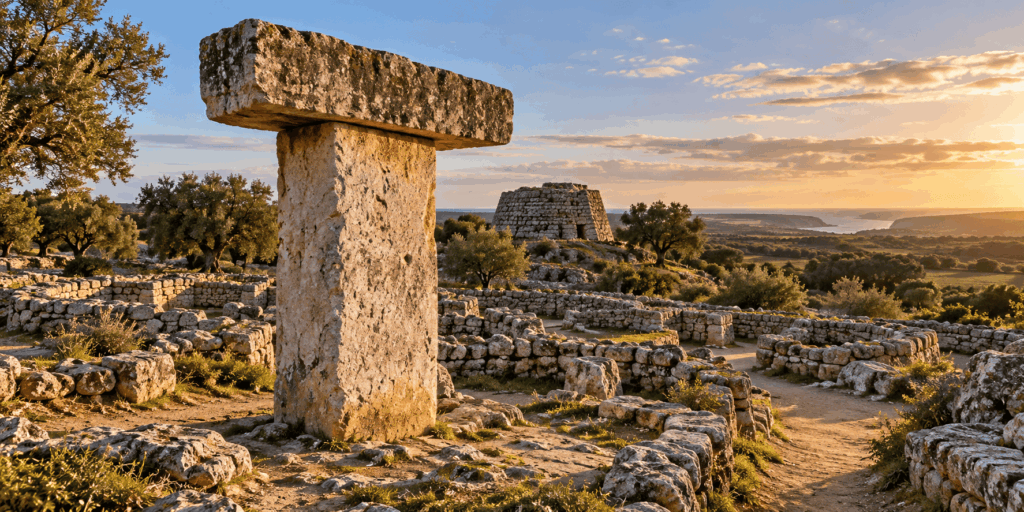
Taulas are one of the most distinctive elements of Menorcan archaeology: large stone structures shaped like a “T” that were associated with ritual spaces.
At Talatí de Dalt you can walk among different remains of the ancient settlement and see how these enormous stones have survived to the present day.
Ideal for
A cultural route around Maó and for seeing a Menorcan taula up close.
- Torralba d’en Salort
Very close to Alaior is Torralba d’en Salort, another of Menorca’s major prehistoric settlements.
Its most spectacular feature is also its taula, one of the most impressive and recognisable on the island.
The site preserves different structures that help you imagine the size and organisation the settlement once had.
You can easily combine Torralba d’en Salort with Alaior and Torre d’en Galmés in the same day.
Ideal for
Photography, archaeology and travellers interested in monumental architecture.
- Trepucó
Trepucó is very close to Maó and is another convenient option if you are exploring eastern Menorca.
The settlement once covered a considerable area, although some of its structures have been lost over time.
Large monumental elements can still be seen, including its talayot and taula enclosure.
Its proximity to Maó makes it easy to combine with a cultural visit to the city.
Ideal for
Travellers staying in Maó, Es Castell or Sant Lluís.
- Cala Morell Necropolis
The Cala Morell Necropolis offers a completely different experience.
Instead of a settlement with structures above ground, here you will find a series of funerary chambers carved directly into the rock.
The complex is set in a spectacular landscape very close to Cala Morell, north of Ciutadella.
You can walk among the different caves and see how funerary practices evolved over different periods.
The visit can also be combined with Cala Morell and a route towards Punta Nati.
Ideal for
Combining archaeology, scenery and the north coast.
- Rafal Rubí Navetas
The Rafal Rubí Navetas are located relatively close to Maó, beside the island’s main road.
They are funerary monuments that allow you to appreciate another of the most characteristic types of construction from Menorca’s prehistory.
They are a good stop if you are travelling between Maó and central Menorca.
You do not need to spend a whole morning there, so they work especially well as a complement to other sites.
Ideal for
Including an archaeological stop on a road trip.
- Son Catlar
Son Catlar is located in the Ciutadella area and is especially interesting because of the size of the ancient settlement and its defensive structures.
One of its main attractions is the wall that surrounded the settlement.
The visit offers a different perspective from other sites and helps you understand how the island’s settlements evolved.
You can combine it with Ciutadella, Son Saura or other places in western and south-western Menorca.
Ideal for
Travellers who want to explore further after visiting the best-known monuments.
A one-day route through Talayotic Menorca
Trying to visit all the major archaeological sites in a single day would be too much.
If you only have one day, it is better to focus on one area.
Option 1: east and central area
Trepucó → Talatí de Dalt → Torralba d’en Salort → Torre d’en Galmés
Start near Maó with Trepucó.
Then visit Talatí de Dalt and continue towards Alaior to see Torralba d’en Salort.
Finish at Torre d’en Galmés, where you can spend more time exploring the settlement.
This is probably the most complete route if your main aim is to see different types of Talayotic structures.
Option 2: western area
Naveta des Tudons → Son Catlar → Cala Morell Necropolis
Start with Naveta des Tudons and continue towards Son Catlar.
In the afternoon you can head to Cala Morell and explore its necropolis.
If the weather is good, ending the day on the north coast or watching the sunset around Ciutadella is a great finale.
How much time should you spend at the sites?
It depends greatly on the size of each place.
For a simple visit, you can roughly allow:
- Small monuments: between 20 and 40 minutes.
- Large settlements: between 1 and 2 hours.
- Necropolises and extensive complexes: around 1 hour.
Do not try to visit too many places in a row. After the third or fourth site, the structures may start to look similar if you do not have enough time to understand them.
It is better to see fewer places and enjoy them properly.
Best time to discover Talayotic Menorca
Spring
One of the best times. The landscape is green and temperatures are very pleasant.
Summer
You can visit the sites, but try to go first thing in the morning or late in the afternoon.
There is little shade in many places.
September and autumn
An excellent time.
Temperatures are milder and it is easy to combine archaeology with towns, hiking and gastronomy.
Winter
It can also be a very interesting and peaceful experience, although you should check opening hours and possible closures.
Practical tips
Wear comfortable footwear
The sites have dirt paths, stones and uneven ground.
Do not climb on the structures
Besides being dangerous, you are standing in front of monuments that have survived for thousands of years. Always respect boundaries and signs.
Check opening hours before you leave
Access systems, opening hours and prices can change depending on the season.
Combine archaeology with other plans
One of the best ways to enjoy the route is to combine a site with a town, a meal or a nearby beach.
Do not try to see everything
Menorca’s archaeology is vast. Choose three or four places and take time to understand them.
Frequently asked questions
What is Talayotic Menorca?
It is the collection of landscapes and archaeological monuments related to the prehistoric communities that inhabited Menorca. It includes talayots, navetas, taula enclosures, houses, funerary caves and other structures.
Is Talayotic Menorca a World Heritage Site?
Yes. Talayotic Menorca was inscribed on the UNESCO World Heritage List in 2023.
What is the most important Talayotic site in Menorca?
There is no single one. Torre d’en Galmés stands out for the size and variety of the settlement, while Naveta des Tudons is probably the island’s best-known prehistoric monument.
How much does it cost to visit the sites?
It depends on the place and the season. Some are free to access while others require an entrance ticket. Always check updated information before visiting.
Can you visit them with children?
Yes. Many are very interesting for families, although children should be supervised because the ground can be uneven and the archaeological structures are not play areas.
Do you need a car?
It is not essential for every site, but it is highly recommended if you want to visit several archaeological sites in one day.
Conclusion
Talayotic Menorca proves that the island is much more than beaches.
Naveta des Tudons, Torre d’en Galmés, Talatí de Dalt, Torralba d’en Salort and the Cala Morell Necropolis allow you to travel thousands of years back in time and discover a culture that left an extraordinary mark on Menorca’s landscape.
You do not need to turn your holiday into a complete archaeological tour.
Choose two or three sites, combine them with towns, gastronomy or nature, and you will discover a side of Menorca that many travellers overlook.
And if you visit the island in September, autumn or spring, Talayotic Menorca is one of the best plans for stepping away from the coast for a few hours and discovering the island’s oldest history.


